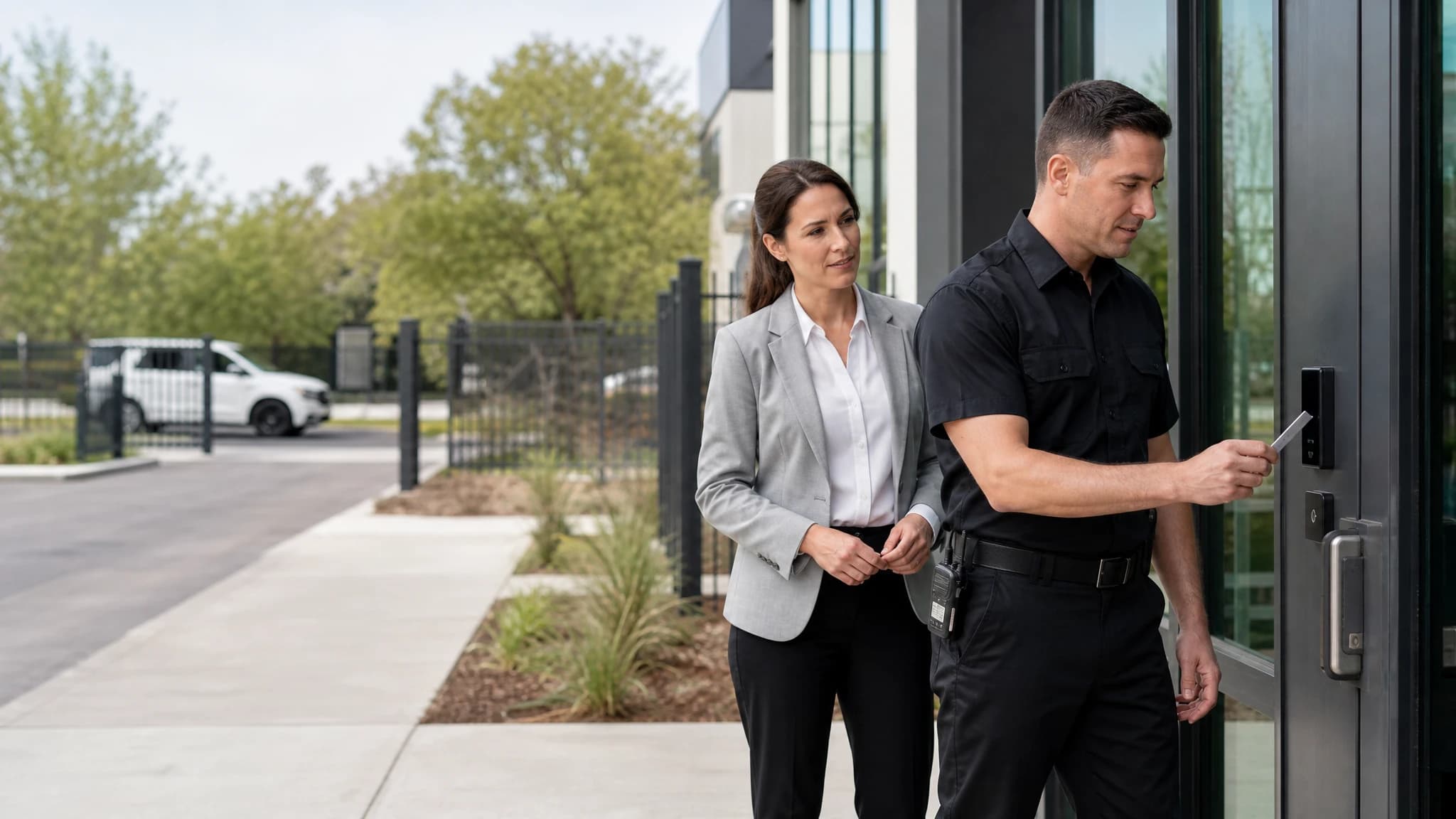
How Much Does It Cost to Hire a Security Guard?
A realistic breakdown of what actually drives security guard pricing -- guard type, hours, location, and contract length -- so you can budget accurately and spot a lowball quote before it costs you.
In this guide
"How much does a security guard cost?" is one of the first questions property owners ask, and one of the hardest to answer with a single number. The honest answer is that it depends on a handful of specific factors -- and once you know what they are, you can get a realistic estimate for your own property in a couple of phone calls instead of guessing.
What actually determines the price
Every quote you get should trace back to a small set of variables:
- Armed vs. unarmed. Armed guards cost more because of the additional licensing, insurance, and training involved.
- Hours and schedule. Overnight, weekend, and holiday coverage typically carry a premium over standard daytime shifts.
- Contract length. A one-off event costs more per hour than an ongoing, long-term post -- companies price in the overhead of constantly restaffing short jobs.
- Level of risk and responsibility. A guard monitoring a quiet lobby costs less than one managing access control at a construction site with expensive equipment on-site.
- Local market. Rates in a major metro area will run higher than in a smaller city, the same way most labor costs do.
Typical rate ranges
As a general guideline, unarmed guards commonly run somewhere in the $20-$35 per hour range, and armed guards commonly run $30-$50 per hour, depending on the factors above. Specialized roles -- executive protection, fire watch on an active job site, or a guard with a specific certification -- can run higher still. Treat any number you see online as a starting point for a conversation, not a quote; the only way to know what your property will actually cost is to describe your situation to a licensed provider.
Costs that don't show up in the hourly rate
A few line items catch people off guard (no pun intended, though we'll allow ourselves exactly one):
- Supervision or management fees, if the contract includes a site supervisor checking in on guards.
- Equipment, like patrol vehicles, radios, or surveillance monitoring tied to the contract.
- Overtime and holiday differentials, which can be meaningfully higher than the base rate.
- Onboarding costs, if your site requires background checks, site-specific training, or a ramp-up period before coverage starts.
Ask for these upfront. A quote that only lists the base hourly rate isn't necessarily hiding something, but it isn't the full picture either.
Why the cheapest quote isn't automatically the best value
It's tempting to sort every quote by price and pick the bottom one. In practice, a rate that's noticeably lower than everyone else's is usually lower for a reason -- less-trained guards, thinner insurance coverage, or a company cutting corners somewhere that eventually becomes your problem. A fair price for the coverage you actually need is a better target than the lowest number on the page.
Getting an accurate quote
The fastest way to get a number you can actually budget against is to describe your property's real needs: hours of coverage, armed or unarmed, and what the guard is responsible for. You can compare licensed security companies directly, or build a quote list and request pricing from a few providers serving your area at once -- that's usually the quickest way to see where the real market rate lands for your specific situation.
Ready to find security?
Find the right security company for your needs
Compare licensed security providers or create a quote request and let us help match you with suitable companies.