Commercial Security for Office Buildings: What Coverage Actually Looks Like
What day-to-day commercial security actually includes for an office building -- access control, front desk presence, patrols, and after-hours monitoring -- and how it's different from a single guard standing in a lobby.

In this guide
Ask someone to picture "commercial security" and most people imagine one thing: a guard standing near the elevators. In practice, office building security is usually a small system of coordinated pieces working together, not a single person holding down a lobby. Knowing what those pieces actually are makes it a lot easier to tell a real coverage plan from a company that's just going to post a body in your lobby and call it done.
What's actually included in office building coverage
A typical commercial security plan for an office building draws from a handful of core pieces, mixed and matched based on the building:
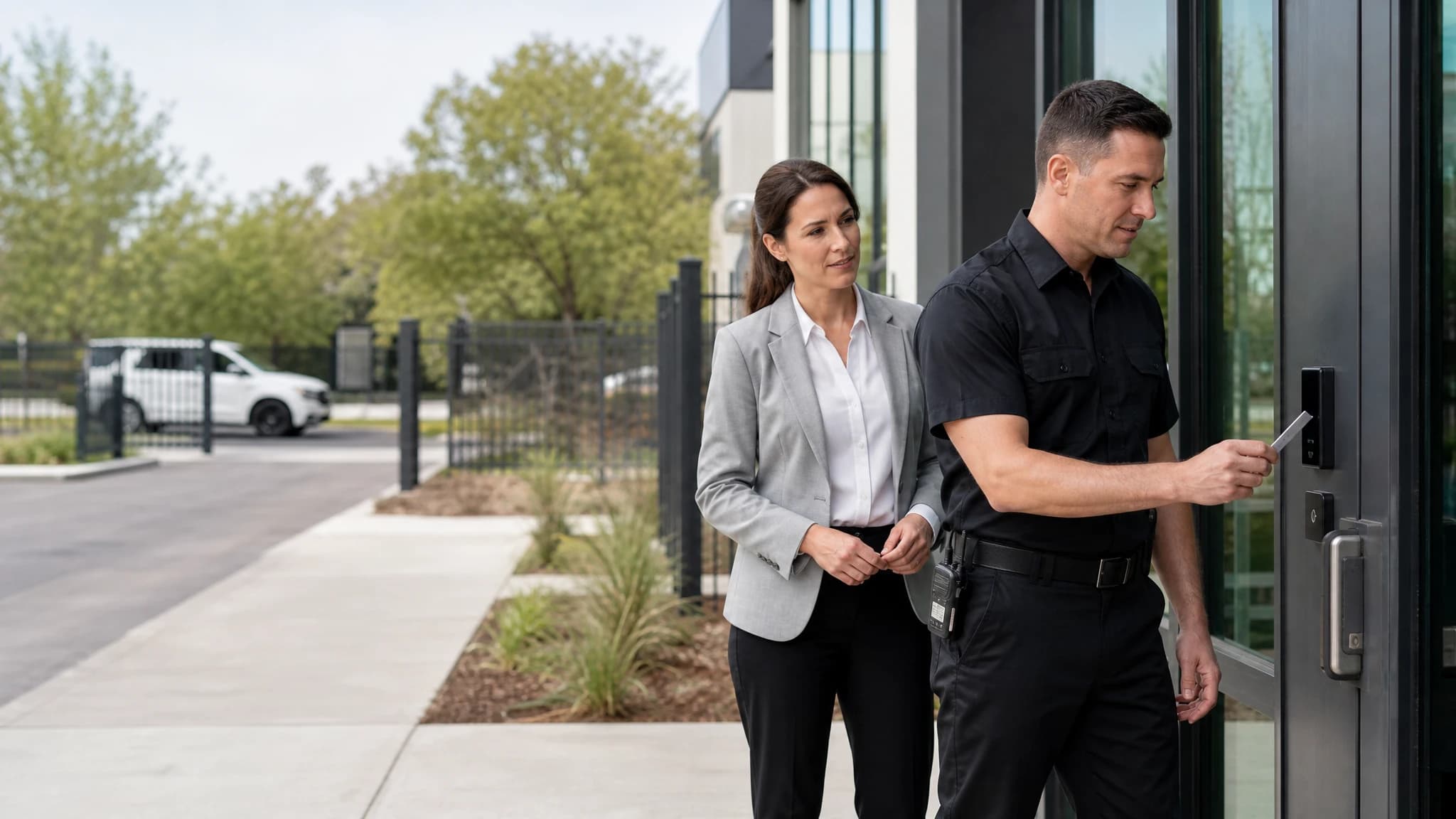
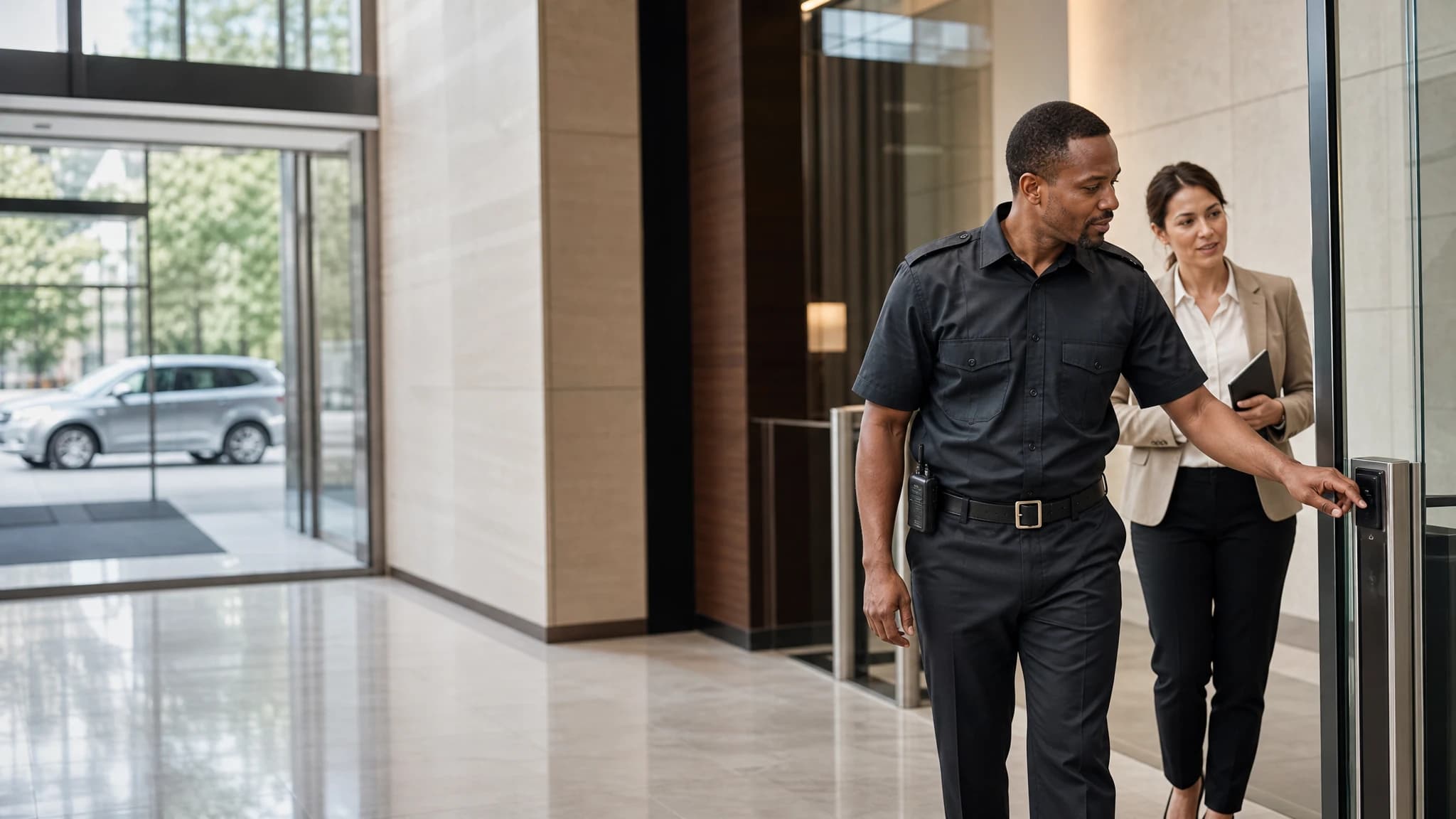
- Access control. Managing who gets in -- badge systems, visitor sign-in, verifying deliveries -- rather than just watching people walk past.
- Front desk or reception presence. A staffed entry point that greets tenants and visitors while also functioning as the building's first line of security.
- Patrols of common areas. Parking structures, stairwells, loading docks, and shared amenity spaces get checked on a schedule, not just watched from one fixed spot.
- After-hours and overnight monitoring. Most incidents at office buildings happen when the building is empty, not during the 9-to-5 rush -- overnight coverage is often the part that matters most and gets thought about least.
- Incident response and coordination with building management. Knowing who to call and what to do when something actually happens, not just noticing that it happened.
Not every building needs all five at full strength. A single-tenant building with controlled parking access needs a different mix than a 20-tenant high-rise with public ground-floor retail.
Why "a guard in the lobby" isn't the same thing
A lobby guard is visible, which is exactly why it's the default mental image -- but visibility isn't the same as coverage. A guard stationed at the front desk generally can't also be checking the parking structure, patrolling the stairwells, or monitoring the loading dock at 2 a.m. If your building's actual risk is in those other areas (and for a lot of buildings, it is), a lobby-only presence looks reassuring without actually addressing it. The honest question isn't "do we have a guard," it's "does our coverage match where the building's actual exposure is."
What determines how much coverage you need
A few factors do most of the work in sizing a plan correctly:
- Number of tenants and entrances. More access points means more places that need to be controlled, not just one front door.
- Hours of operation. A building with 24-hour tenant access needs a fundamentally different plan than one that's empty by 7 p.m.
- Single-tenant vs. multi-tenant. Multi-tenant buildings usually need more formal visitor management, since staff can't rely on simply recognizing everyone who walks in.
- On-site amenities. Parking structures, gyms, or conference centers open to outside groups all add exposure that a lobby-only plan won't cover.
Questions worth asking before you sign
- How does your access control integrate with our existing badge or visitor system? A provider who can't answer this clearly probably hasn't done it before.
- What does overnight coverage actually consist of? "We patrol overnight" can mean an hourly walkthrough or it can mean nobody's there until a resident calls -- ask for specifics, not the phrase.
- Who's our building's actual point of contact, and how fast do they respond? Coverage is only as good as how quickly a real person shows up when something's wrong.
- How do you coordinate with our property management company? Building security that operates in its own silo, disconnected from whoever runs the building day-to-day, tends to fall apart exactly when it matters.
And yes, if a company's entire pitch is "we'll put a nice-looking guy in a blazer by the elevators," that's a receptionist with a radio, not a security plan.
Matching the plan to the building, not the other way around
The properties that get the best value out of commercial security aren't the ones with the most guards -- they're the ones where the coverage plan actually maps to how the building is used: who's in it, when, and through how many doors. Start there, and the right level of coverage (and the right price for it) tends to follow naturally.
If you're evaluating options, you can compare commercial security companies serving your building's area, or build a quote list to get a coverage plan and pricing from a few providers at once.
Ready to find security?
Find the right security company for your needs
Compare licensed security providers or create a quote request and let us help match you with suitable companies.